




The transition to FSSC 22000 Version 6.0 fundamentally changes how food manufacturers must approach digital risk in pest management. With “malicious computer hacking” now a mandatory 3-day reporting trigger for serious events, uploading sensitive factory data—such as floor plans, biological risks, and rodent trends—into third-party cloud AI or BI tools can introduce data management and cybersecurity risks, particularly if the organization lacks adequate contractual, access, and data usage controls. Adopting an offline-capable analysis software with a localized SQLCipher AES-256 encrypted database is a strategic approach to generating trend analyses and IPM programs, significantly strengthening organizational control over data and reducing external exposure.
The Regulatory Shift: FSSC 22000 v6 and the Risks of Cloud Data Storage
The transition from FSSC 22000 Version 5.1 to Version 6.0 represents a transformative shift in Food Safety Management Systems (FSMS), explicitly bringing technical oversight and industrial data integrity to the forefront. For the Chief Information Security Officer (CISO) and the Quality Assurance (QA) leader, the most significant change lies in the professionalization of digital risk and data leakage management.
Under Section 2.5.17, the Scheme now mandates a strict 3-working-day reporting window for “Serious Events,” explicitly naming malicious computer hacking among its examples. When an organization uploads its pest control and QA data—including detailed factory maps and biological hazard assessments—to cloud-based servers for analysis, it increases its attack surface. Implementing an offline-capable desktop analysis system, optimized for AI applications, significantly reduces exposure to third-party data breaches, supporting the organization’s data protection efforts.
Local Hazard and Trend Analysis: Professional Decision Support Without the Cloud
Pest management audit compliance goes beyond simple data recording. From raw data—such as rodent trap catches and insect monitor statistics—auditors expect professional visual trend analyses and meaningful biological hazard assessments. Many organizations use external servers, Power BI dashboards, or other cloud-based BI solutions for these calculations and visualizations, which can increase exposure.
By contrast, IPMFlow Desktop brings the analysis engine directly to the user’s computer. Whether extrapolating pheromone trap timelines, algorithmically examining the biological patterns of rodent activity, or generating complex executive summaries from the data, the software can perform all these operations in a closed environment without a network connection (Wi-Fi or cellular). Consequently, sensitive factory performance metrics are not subjected to internet traffic yet can still be professionally analyzed.
Personalized IPM Programs and Corrective Actions: The Power of Offline Software
In high-risk manufacturing environments, such as Food Manufacturing (Category C) and Packaging Material (Category I), the Integrated Pest Management (IPM) program must be unique, continuously updated, and data-driven (Sections 2.5.9 and 2.5.11).
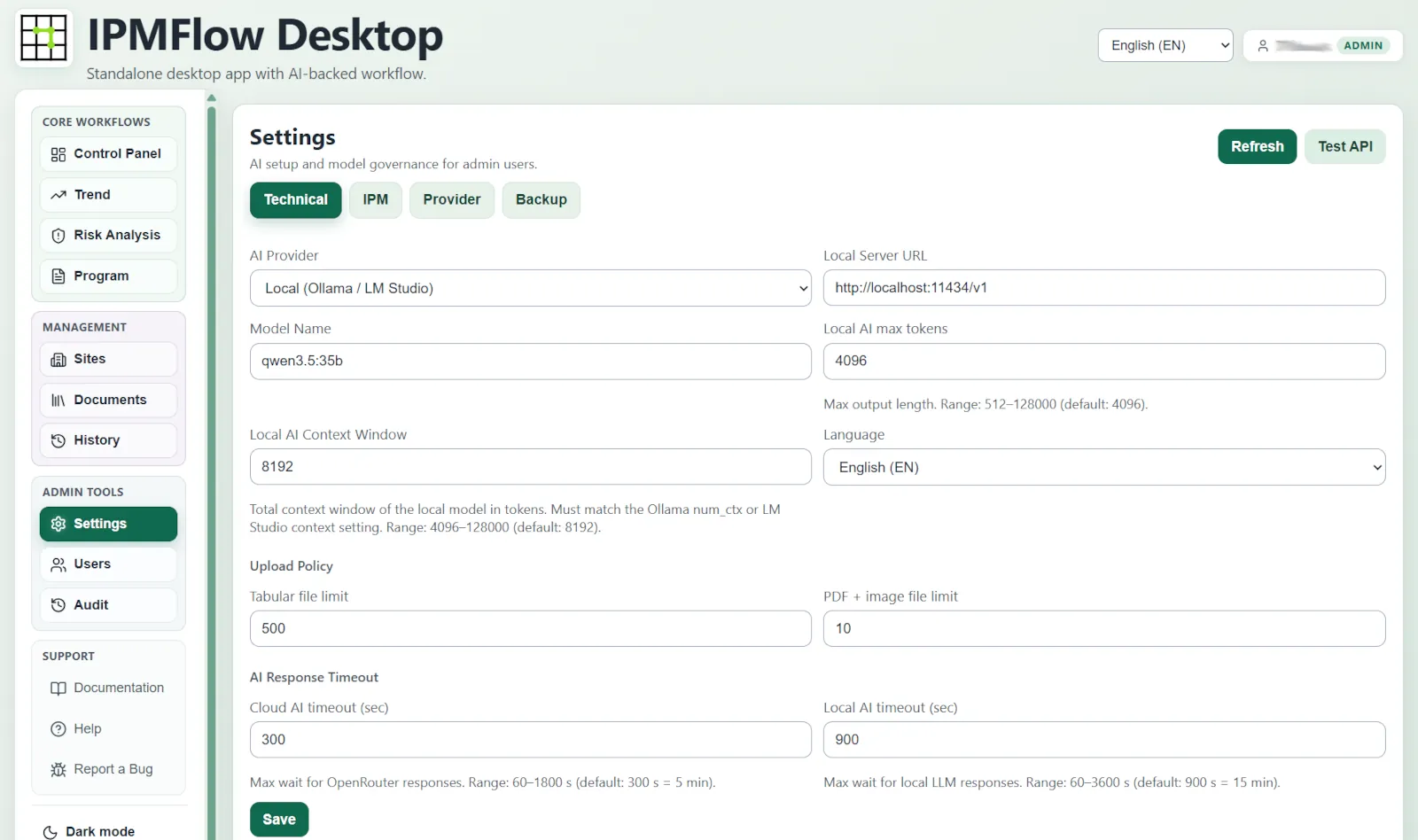
Designing an appropriate and professionally structured IPM program requires tremendous industry knowledge and contextual interpretation, an area where Artificial Intelligence (AI) provides massive support to pest control professionals. IPMFlow Desktop enables experts to generate deep, localized action plans and preventive strategies using locally run AI models (like Ollama) in a closed environment, based on site-collected data. This allows facilities to leverage modern AI decision-making support without sensitive factory data or proprietary recipes entering the data processing environments of external, cloud-based AI services.
Data Integrity and the CISO: The Role of SQLCipher AES-256 Encryption
For the modern CISO, FSMS integrity is organically tied to industrial-grade security. The FSSC 22000 mandates for Food Defense (Section 2.5.3) and Food Fraud Mitigation (Section 2.5.4) justify the need for organizations to manage the integrity of their digitally handled IPM and QA data using a risk-based approach. Since IPMFlow Desktop stores sensitive trends, mapped floor plans, and risk assessments in a local database on the installed workstation, it is crucial that the database is encrypted using industry-standard SQLCipher AES-256.
- Strengthens Control Over Data: If the endpoint is physically compromised, 256-bit encryption significantly complicates unauthorized access to the locally stored IPM data.
- Supports a Defensible Security Posture: It can help demonstrate that the organization applied adequate technical safeguards to sensitive IPM and QA data during the review of “Serious Events.”
- Reduces the Risk of Manipulation: The encryption and integrity-check mechanisms can assist in detecting unauthorized modifications within local analyses.
This architecture not only supports safe data storage but also mitigates the risk of unauthorized manipulation of the source data used by analytical algorithms.
Audit-ready pest control – right on your own PC
Generate IFS, BRCGS, and HACCP compliant trend analyses with IPMFlow Desktop. Local data storage, full network isolation (air-gap) and free AI models.
Readiness for Unannounced Audits: Data-Centric Report Generation
Data sovereignty and offline intelligence become critically important during the unannounced audits mandated by FSSC 22000 Part 3, Section 5.4. When an auditor arrives without notice, the relevant monitoring, trend, and corrective action documentation must be made accessible to the auditor without delay.
The built-in rendering engine of an offline-capable analysis software can generate clear, corporate-standard reports and charts without relying on an internet connection. This ensures that the auditor instantly receives professional documentation prepared on-site, supporting an adequate posture of security and operational readiness.
Strategic Implementation: Aligning Software Features with FSSC v6 Expectations
Selecting compliance software is no longer merely an IT question: it is an integral part of Food Safety and Quality Culture (Section 2.5.8). Implementing offline, local AI analysis solutions elevates workflows, transforming mere data collection into genuine decision support.
For the CISO and QA leader, an encrypted, network-independent desktop analysis system like IPMFlow Desktop is an investment in predictability. The prudent handling of a facility’s production data is now a guiding principle to support a pest management service that helps fulfill a client’s FSSC 22000 v6 audit readiness.
Compliance Note: IPMFlow provides audit-supported analytical and encryption features; the article quotes FSSC 22000 guidelines for informational purposes. Actual compliance depends on the implementation environment, organizational processes, and validation by a professional.
Frequently Asked Questions
Why can the use of cloud-based intelligence in pest control introduce security risks under FSSC 22000 v6?
Under Section 2.5.17, “malicious computer hacking” is deemed a serious event representing a significant audit risk. Feeding factory data, risk floor plans, and QA trends into cloud-based machine learning models can create data handling pathways and cyber risks where oversight may fall outside the scope of internal quality assurance. Offline systems using local analysis lower this data exposure risk.
How can offline software compute complex trend analysis without an internet connection?
The desktop software actually provides a secure framework: it structures the recorded data (like trap catch counts and insect detections) and passes it in the form of a precisely formulated prompt to a local AI model running on the user’s machine (e.g., a physically isolated LLM). The complex trend analysis itself is performed by this isolated, offline local artificial intelligence utilizing the machine’s own resources (CPU/GPU), while the software formats the results into visual, transparent reports.
How does SQLCipher AES-256 encryption protect our IPM program?
The industry-standard local encryption of SQLCipher AES-256 helps ensure that generated action plans, trend analyses, and visual data remain encrypted when at rest. This supports compliance with the stringent data integrity standards of Food Defense (Section 2.5.3) by impeding unauthorized access.
